

What Is an MSP Platform, and When Do You Actually Need One?
Six dashboards, four vendors, and no single answer to "are all clients protected?" - the problem an MSP platform exists to solve.
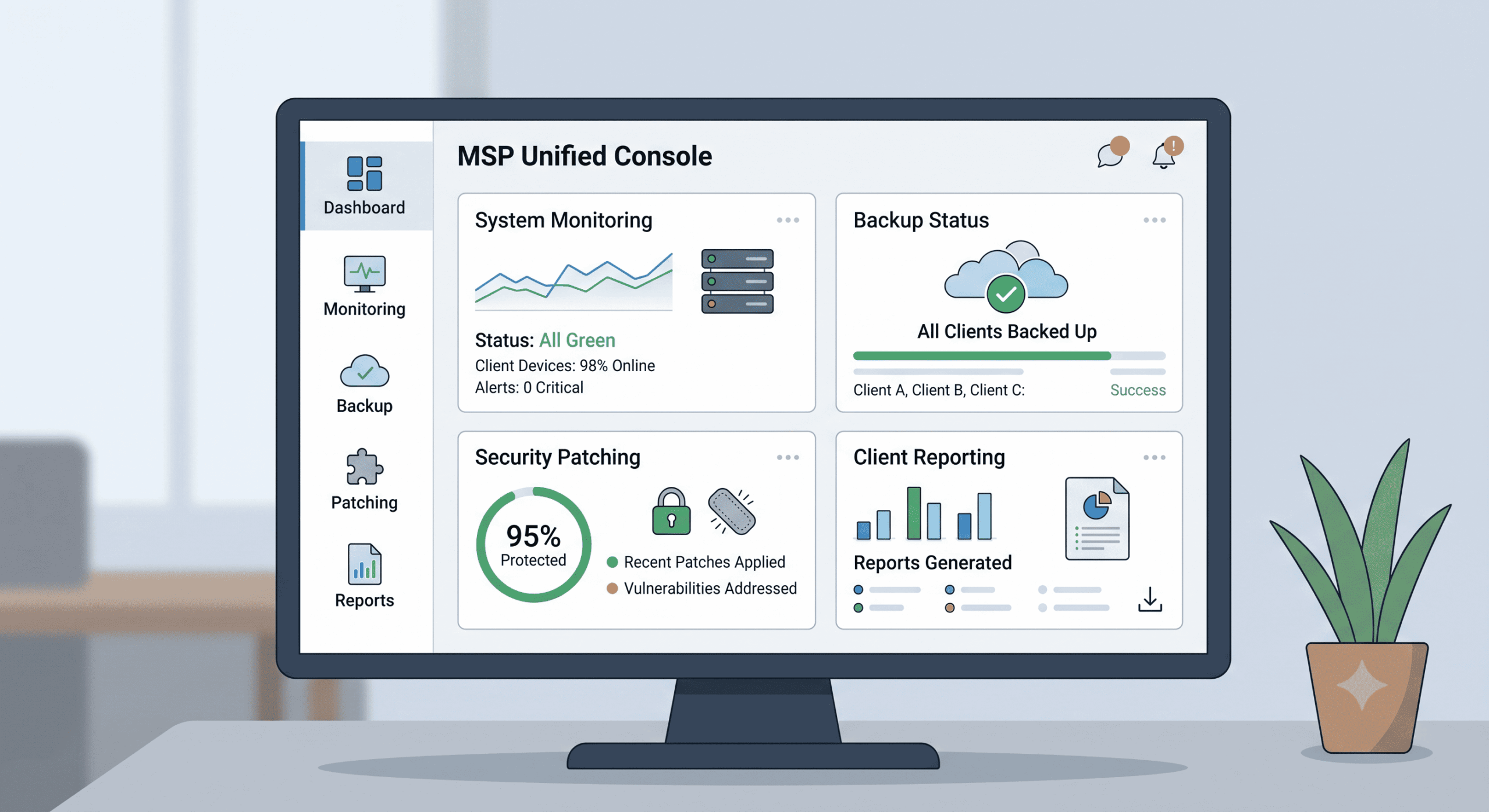
An MSP technician starts the morning with six browser tabs: the backup console, the monitoring tool, the patch manager, the ticketing system, the EDR dashboard, and a spreadsheet gluing them together. A client calls asking a simple question - "is everything of ours protected and up to date?" - and the honest answer requires checking all six. Multiply by eighty clients, and the tooling that was supposed to enable the service has become its main overhead.
An MSP platform is the structural answer: one multi-tenant console that unifies monitoring, backup, patching, security, and reporting across every client environment. Not a convenience feature - the difference between a service business that scales with clients and one that scales with browser tabs.
The misconception to address: an MSP platform is "just another tool." A platform is the opposite of another tool - it is the consolidation layer that reduces the tool count, and its value shows up in exactly the places tools don't: margins, response times, and the client-facing question "can you prove it?"
What Does an MSP Platform Actually Do?
At its core, an MSP platform is a centralized, multi-tenant management layer over all client IT environments. The functional pillars:
The Four Pillars
Unified monitoring and remote management (RMM). Real-time visibility into every managed device and network, with remote remediation - the technician fixes the failing service before the user notices it failed.
Backup and recovery orchestration. Per-client backup policies, job monitoring, and restore operations from the same console - including verification that copies are immutable and restorable, not merely scheduled.
Automated routine work. Patch deployment, software updates, scripted diagnostics, and password resets run as policies rather than tickets.
Multi-tenant administration and reporting. Strict client separation, role-based access, and white-label reports per tenant - the artifact the client's auditor and insurer actually read.
Do You Need a Platform, or Are Separate Tools Fine?
Separate best-of-breed tools work at small scale - roughly until the number of clients times the number of consoles exceeds what a team can hold in their heads. The signals that the threshold is passed are consistent: client-status questions take research instead of a glance; onboarding a new client means configuring five systems; incidents are discovered by users rather than alerts; and reporting is a monthly copy-paste exercise nobody trusts.
There is also a risk-side answer. Tool sprawl doesn't just cost time - it creates the gaps attackers use, and MSPs are priority targets precisely because one compromised provider opens many client doors, a pattern ENISA's threat landscape work documents in its supply-chain analysis. A consolidated platform with unified RMM and EDR shrinks both the blind spots and the credential surface.
The Business Case: Where the Hours and Margins Go
The platform's ROI is concrete and measurable. Automation reclaims the routine layer: software updates that consumed hours per week per technician become scheduled policies; diagnostics that took an hour become a script's output; backup verification across all tenants becomes a dashboard column instead of a checklist. Teams commonly reclaim the equivalent of a day per technician per week - capacity that goes to billable project work instead of maintenance.
The second half of the case is what the platform lets you sell. Regulated clients under the NIS2 Directive must demonstrate risk management and tested recovery - duties many discharge through their MSP. A platform that generates per-client compliance reports, backup evidence, and patch status on demand turns that regulatory pressure into a service tier. Add EU-hosted infrastructure and the sovereignty answer (no US CLOUD Act exposure) closes deals that hyperscaler-based stacks cannot.
Choosing and Adopting a Platform: A Five-Step Plan
Inventory your current stack and its costs. List every tool, license, and the weekly hours spent swivel-chairing between them - the baseline your business case is measured against.
Insist on true multi-tenancy and white-labeling. Client separation must be structural (not folder-deep), and reporting must carry your brand - evaluate the MSP management platform capabilities against your largest client's audit requirements, not your smallest client's needs.
Verify the backup layer's independence. The platform should orchestrate immutable, EU-hosted MSP backup with storage isolated from the RMM credential space - so a platform compromise cannot reach the recovery layer.
Migrate in waves, automate as you go. Move a pilot cohort of clients first, codify the runbooks the platform replaces, and convert each manual routine into a policy before migrating the next wave.
Measure and report the delta. Track time-to-resolution, patch latency, backup success rates, and hours reclaimed - both to steer adoption and as the proof points for client conversations.
Separate Tools vs. Platform: The Operational Comparison
| Separate tools | MSP platform | |
|---|---|---|
| Client status check | Multiple consoles + spreadsheet | One dashboard |
| New client onboarding | Configure 4-6 systems | One tenant provisioning flow |
| Routine maintenance | Manual, per-client | Policy-driven, automated |
| Compliance reporting | Assembled by hand monthly | Generated per tenant on demand |
| Security surface | Many credential sets, many gaps | Unified access control, fewer blind spots |
| Scaling cost | Linear with clients (headcount) | Sub-linear (automation absorbs growth) |
The last row is the strategic one: an MSP whose costs scale sub-linearly with clients can win on price or on margin. One whose costs scale with browser tabs can do neither for long.
Conclusion
An MSP platform is not a gadget purchase - it's the decision about what your service business scales on: automation and a single operational truth, or headcount and heroics. The functional test is simple: can any technician answer "is this client fully protected, patched, and recoverable?" in one glance, and can you hand the client a report proving it? If yes, you have a platform; if it takes six tabs and a spreadsheet, you have overhead wearing a tools budget. If you'd like to see how a unified, EU-hosted platform would map onto your current stack, we're glad to walk through it with you.
Frequently Asked Questions
What is an MSP platform?
An MSP platform is a centralized, multi-tenant management system that lets a managed service provider operate all client IT environments from one console: monitoring and remote management, backup orchestration, patch automation, security tooling, and per-client reporting. It replaces the sprawl of separate per-function tools with a single operational layer, with strict separation between client tenants and role-based access for technicians.
How does an MSP platform improve security?
Consolidation reduces the attack surface in two ways: fewer separate credential sets and consoles for attackers to target, and fewer monitoring blind spots between tools where incidents go unnoticed. A good platform adds unified patch automation (closing known vulnerabilities faster), integrated endpoint detection, and backup orchestration with immutable, isolated storage - so that even a compromise of the management layer cannot reach the recovery layer.
When should an MSP switch from separate tools to a platform?
The practical threshold is when tool overhead measurably eats service quality: client-status questions require research across multiple consoles, onboarding means configuring several systems per client, incidents surface via user complaints rather than alerts, and monthly reporting is assembled by hand. At that point the platform's automation typically reclaims enough technician time to fund itself, while multi-tenant reporting unlocks the compliance-oriented service tiers regulated clients ask for.