

When the Attack Comes Through a Vendor: Runbooks That Hold Up
Supply chain attacks arrive with valid signatures and trusted update channels — your response plan has to assume the trusted path is the threat.
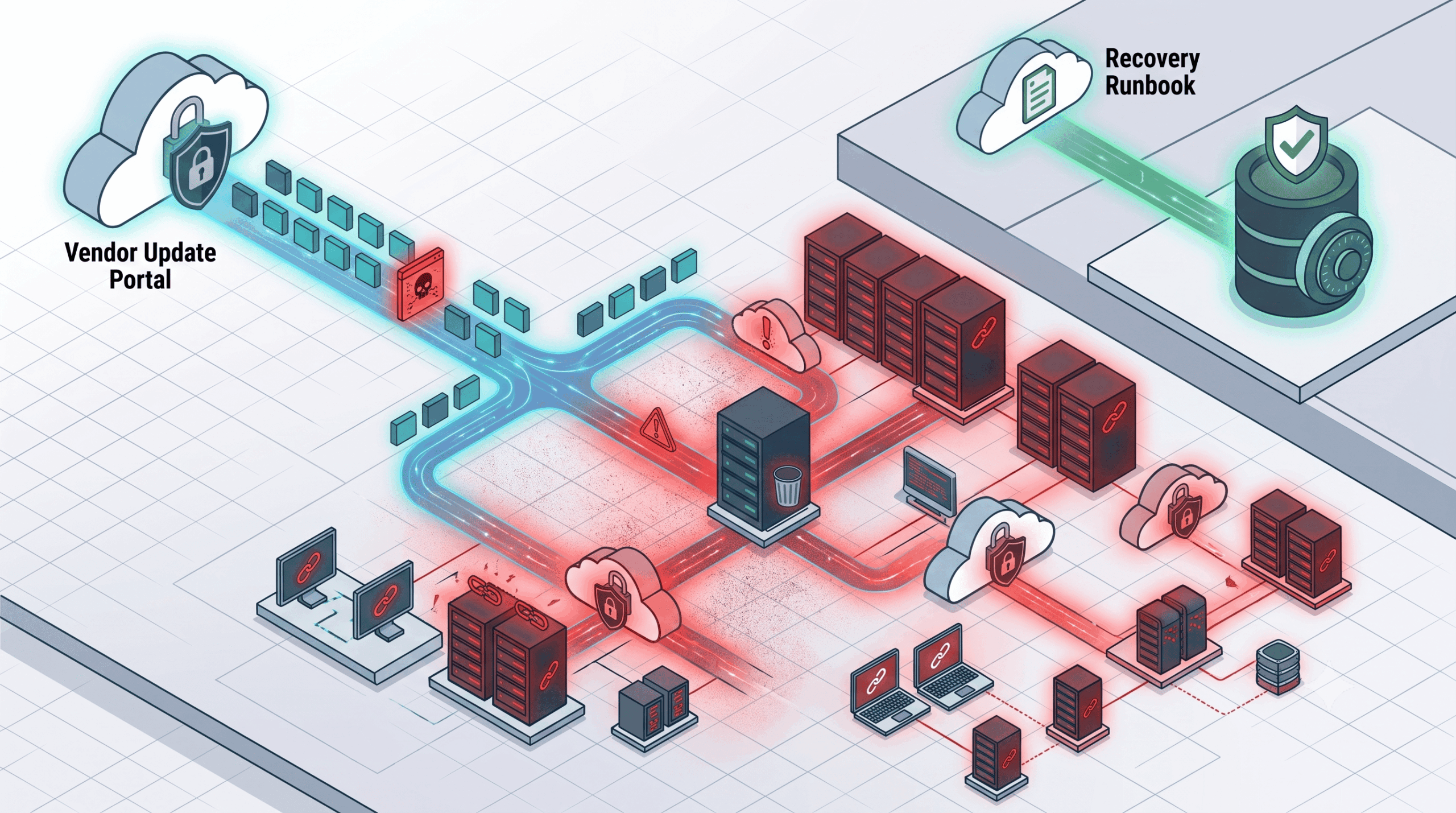
The monitoring agent your IT team relies on updates itself overnight, as it has hundreds of times before. This time, the update carries someone else's code. By morning, an attacker has a foothold on every endpoint the agent touches — installed by your own tooling, signed by a vendor you chose. No phishing email, no exploit, no user mistake.
This is what makes supply chain attacks categorically different: the attack vector is a relationship you trust and cannot simply block. Incidents such as the 2025 npm ecosystem compromise flagged by CISA showed how a single upstream compromise fans out to thousands of organizations at once. The NIS2 Directive treats supply chain security as an explicit obligation for exactly this reason.
The misconception to abandon: incident response can be improvised by experienced staff when it happens. Against supply chain attacks — where you don't control the entry point and the blast radius is defined by software you didn't write — improvisation loses to a written, tested runbook every time.
What Is a Supply Chain Defense Runbook?
A supply chain defense runbook is a documented, step-by-step response procedure for incidents that originate in third-party software, services, or vendors. It differs from a generic incident response plan in one key assumption: the compromise arrived through something you trust and depend on, so the response must work even while that dependency is quarantined.
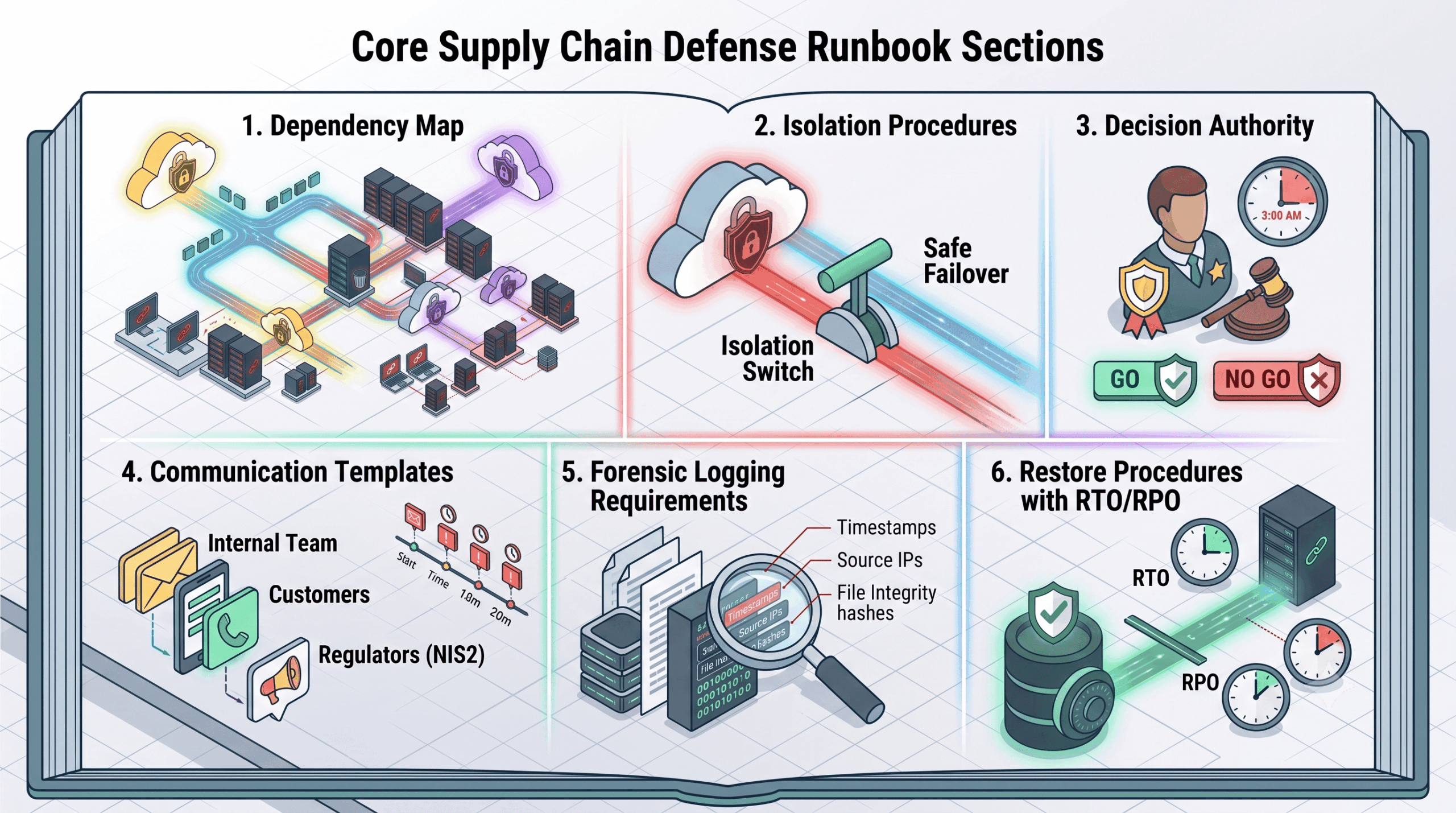
What Belongs in the Runbook
The core sections are: a dependency map (which vendors, agents, libraries, and cloud services touch which systems), isolation procedures per dependency (how to cut off a vendor's access without collapsing operations), decision authority (who may disconnect production systems at 3 a.m.), communication templates (internal, customers, regulators — NIS2 early warnings are due within 24 hours), forensic logging requirements, and restore procedures with defined RTO/RPO per system.
Why Can't Normal Security Controls Stop These Attacks?
Because the controls are aimed at untrusted input, and supply chain attacks arrive as trusted input. Signature checks pass — the attacker compromised the signing process. Update channels are allowlisted — the update channel is the vector. The software behaves normally for weeks — the malicious payload activates on a schedule or command.
What remains effective is limiting blast radius and preparing recovery: least-privilege deployment of third-party agents, segmentation that keeps vendor tooling away from crown-jewel systems, behavioral monitoring that flags a trusted process acting out of character, and — decisively — a recovery capability that doesn't depend on the compromised chain. Prevention has a ceiling here; response depth is where organizations differentiate.
What a Vendor Compromise Costs Without a Plan
The damage pattern of supply chain incidents is breadth: one compromise, hundreds of affected systems, simultaneously. Organizations without a runbook typically lose the first hours to questions a document should have answered — which systems run this software? who can approve isolation? do we have clean backups, and from before when?
The regulatory clock runs regardless. Under the NIS2 Directive, in-scope entities must manage supply chain risk explicitly and report significant incidents within 24 hours of awareness — evidence of prepared, tested response procedures is precisely what supervisors ask for afterwards. The financial stakes match: according to IBM's Cost of a Data Breach Report, breaches involving third parties are among the costliest and slowest to contain, against a global average of USD 4.88 million per breach in 2024.
How to Build the Runbook: A Five-Step Plan
Map your dependencies. Inventory every third-party agent, SaaS integration, and software dependency, and record which systems each one touches. This map is the foundation — without it, step 2 is guesswork.
Define isolation procedures per dependency. For each critical vendor, script how to revoke access, block updates, and quarantine affected endpoints — including the business impact of doing so, so the 3 a.m. decision is pre-made.
Set recovery objectives and wire in backups. Define RTO/RPO per system and back them with immutable, EU-hosted copies via a managed backup-as-a-service — stored outside the reach of any vendor tooling, so restoring never depends on the chain that failed.
Prepare the communication layer. Draft templates for internal escalation, customer notice, and the NIS2 24-hour early warning, with named owners for each.
Test with simulations, then iterate. Run tabletop exercises simulating a compromised update from a real vendor on your map; measure time-to-isolation and restore success, document the gaps, fix them, repeat quarterly.
Detection, Isolation, Recovery: Where Each Layer Earns Its Keep
| Phase | Objective | Key capability | Fails without |
|---|---|---|---|
| Detection | Spot the trusted process misbehaving | Behavioral monitoring, EDR | Baseline of normal behavior |
| Isolation | Contain without collapsing operations | Scripted per-vendor cutoff | Dependency map, decision authority |
| Recovery | Restore to a pre-compromise state | Immutable, independent backups | Copies outside the compromised chain |
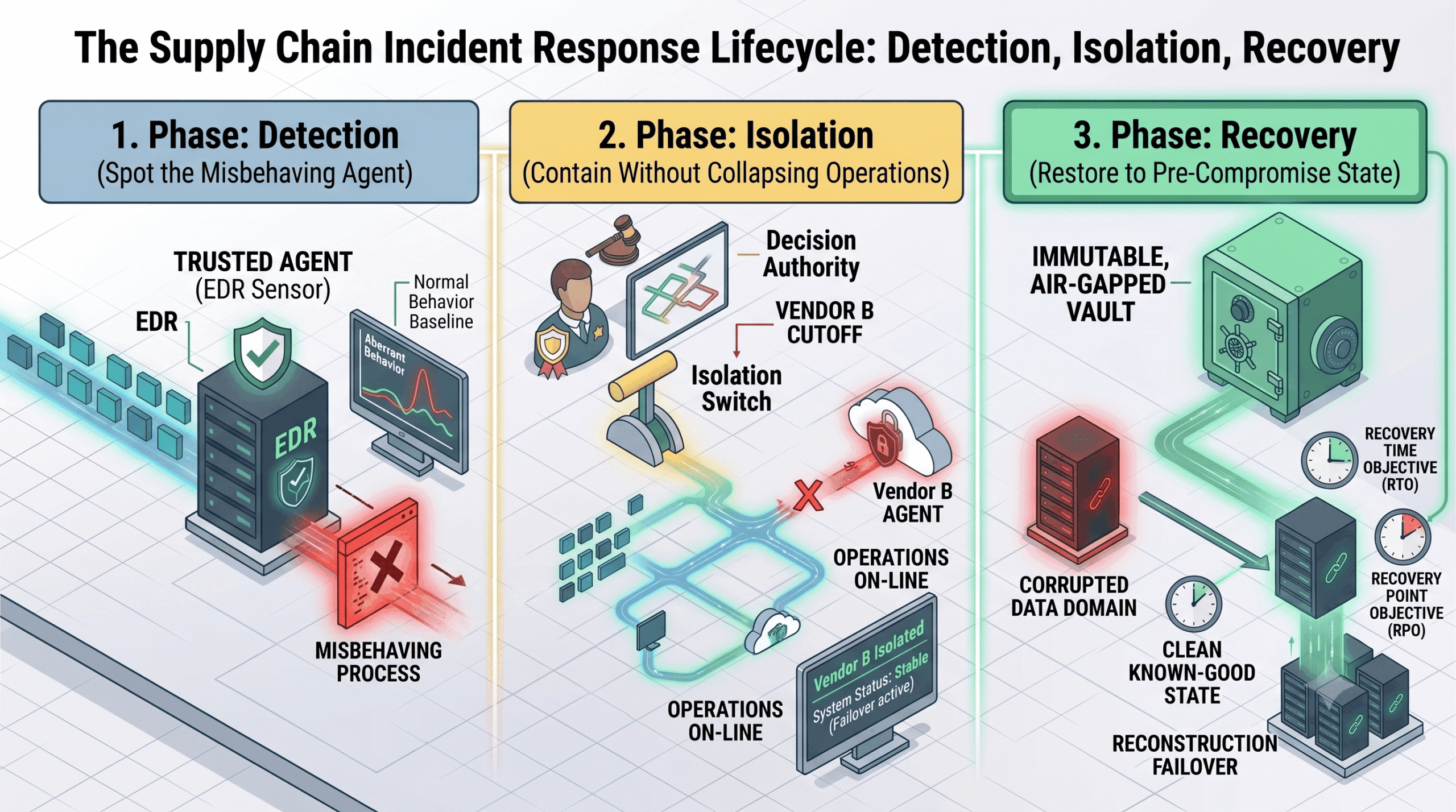
The recovery row deserves the emphasis it rarely gets. If your backups are managed by the same compromised agent, reachable with the same credentials, or hosted in the same trust domain, the supply chain attack owns them too. Independent ransomware protection with air-gapped, immutable copies — and a tested disaster recovery path to fail over while endpoints are rebuilt — is what makes "restore to a known good state" a real sentence instead of a hope.
Conclusion
Supply chain attacks turn your vendors' weakest link into your incident, and they punish improvisation more than any other attack class: the entry point was trusted, the spread was instant, and the first hours decide the outcome. A defense runbook — dependency map, scripted isolation, pre-assigned authority, and recovery that stands outside the compromised chain — converts those hours from panic into procedure. If you want to pressure-test whether your current recovery path would survive a vendor compromise, we're glad to walk through the scenario with you.
Frequently Asked Questions
What is a supply chain attack in IT?
A supply chain attack compromises an organization through the software, services, or vendors it trusts, rather than attacking it directly. Typical vectors include poisoned software updates, compromised open-source packages, and breached managed service providers. Because the malicious code arrives through legitimate, often digitally signed channels, conventional perimeter and signature-based defenses usually fail to detect it.
What should a supply chain defense runbook contain?
The essential components are a dependency map linking vendors and software to the systems they touch, scripted isolation procedures for each critical dependency, named decision authority for disconnecting systems, communication templates including regulatory notifications, forensic logging requirements, and tested restore procedures with defined RTO/RPO targets. The runbook should be reviewed and exercised quarterly so it reflects the current vendor landscape.
How does NIS2 address supply chain security?
NIS2 makes supply chain security an explicit risk-management obligation: in-scope entities must assess and manage the cybersecurity risks of their suppliers and service providers. It also imposes tight incident-reporting timelines — an early warning within 24 hours of becoming aware of a significant incident. Documented, tested response procedures and demonstrable recovery capability are the practical evidence supervisors expect organizations to produce.