

Why Healthcare Backups Need Threat Hunting Before the Attack
Ransomware dwells in hospital networks for weeks before encrypting — if it reaches your backups first, restoring becomes reinfecting.
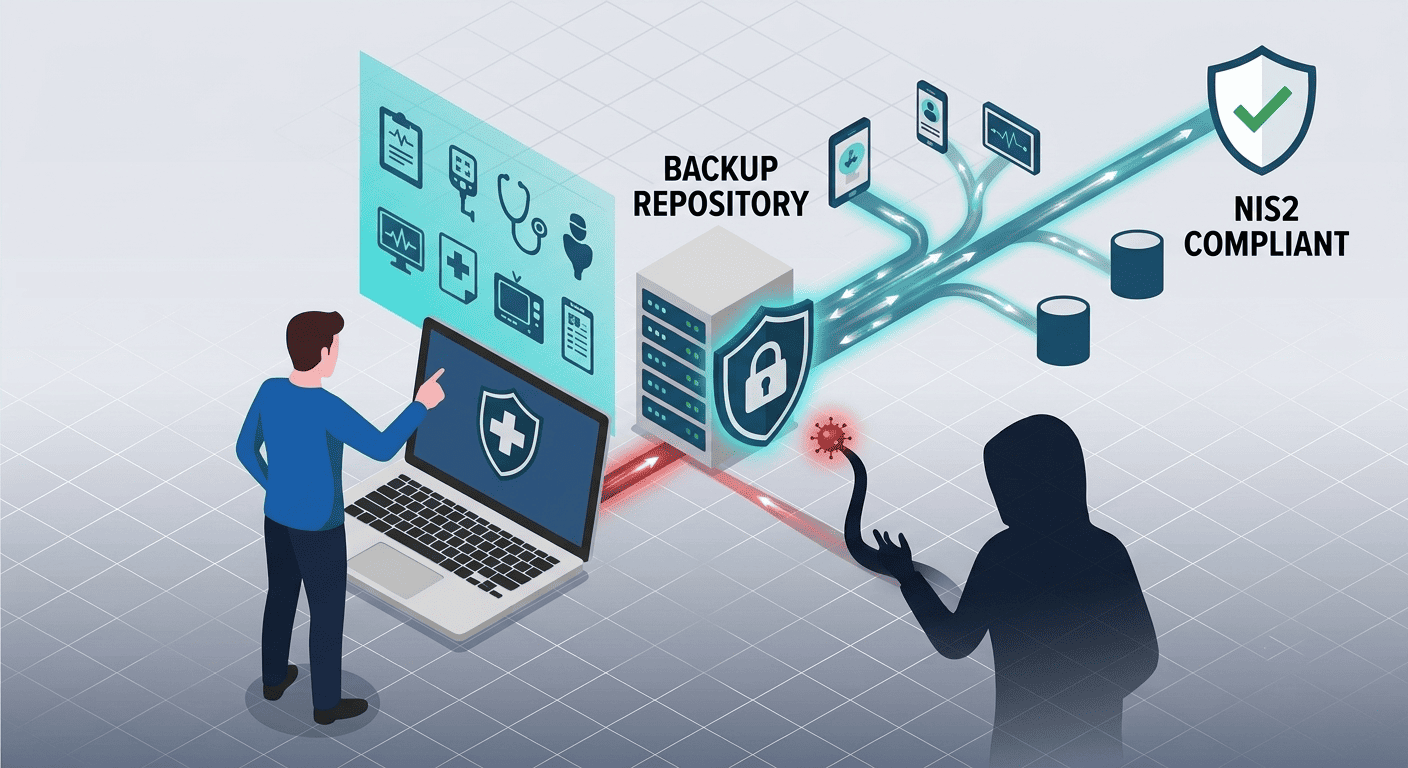
A regional hospital gets hit by ransomware on a Saturday night. The IT team stays calm: backups exist, the recovery plan is documented. Then the restores start failing — the attackers had been inside the network for three weeks, and every backup taken in that window contains their persistence mechanisms. Restoring means reinfecting. What should have been a 48-hour recovery becomes a multi-week crisis with postponed procedures and diverted patients.
This is why backup threat hunting exists: systematically searching backup environments for signs of compromise before you need them, so the copies you depend on are actually clean. In healthcare, where downtime translates directly into patient risk, and where NIS2 and GDPR demand demonstrable recovery capability, hoping backups are clean is not a strategy.
The misconception to correct: "we have backups, so ransomware can't hurt us." Backups you have never inspected or test-restored may be exactly as compromised as the systems they came from.
What Is Backup Threat Hunting?
Backup threat hunting is the proactive search for hidden threats inside backup systems and restore points — before an incident makes them load-bearing. Rather than waiting for alerts, a hunt team forms hypotheses ("if an attacker were in our EHR environment, what traces would appear in backups?") and actively looks for evidence.
What Hunters Look for in Backup Environments
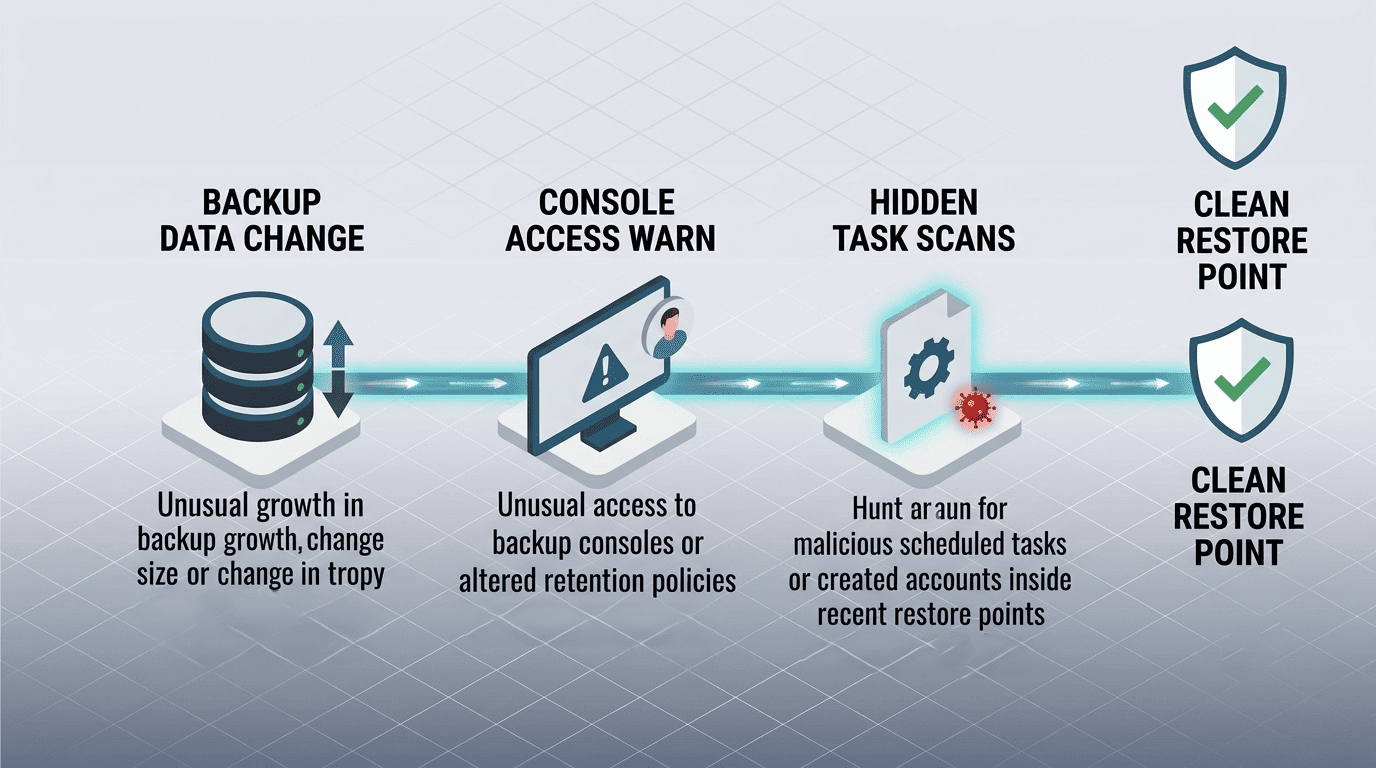
Typical signals include anomalous changes in backup size or deduplication ratios (mass encryption changes data entropy), unusual access to backup consoles or repositories, disabled or shortened retention policies, restore points containing known indicators of compromise, and scheduled tasks or accounts created shortly before backup jobs. Each is a cheap check; together they form an early-warning layer that conventional endpoint security does not provide.
Why Is Healthcare Such a Heavy Target?
Because downtime is leverage. An encrypted logistics firm loses money; an encrypted hospital loses the ability to treat patients — which is why attackers expect faster payment. According to ENISA's threat landscape analysis for the health sector, ransomware accounts for the majority of cybersecurity incidents affecting EU healthcare organizations, with patient data and care continuity as primary targets.
Healthcare also offers structural weaknesses: legacy clinical systems that cannot be patched, sprawling networks of connected medical devices, and vendor-managed systems that widen the supply-chain attack surface. Attackers increasingly automate their reconnaissance, probing for backup consoles and shadow copies as a first step — because a victim without usable backups has no alternative to paying.
What Failed Backups Cost a Healthcare Organization
The consequences stack in three layers. Clinical: postponed procedures, diverted emergency patients, and clinicians working from paper — with measurable patient-safety impact. Regulatory: under the NIS2 Directive, healthcare entities must implement backup management and crisis procedures, and essential entities face fines of up to €10 million or 2% of global turnover for non-compliance; GDPR breach obligations arrive on top when patient data is exposed. Financial: according to IBM's Cost of a Data Breach Report, healthcare has been the most expensive sector for data breaches for over a decade, with average costs far above the cross-industry mean.
Insurers have followed the data: cyber policies increasingly require proof of immutable backups and tested recovery before covering healthcare clients. A managed ransomware protection setup with isolated, unalterable copies is rapidly shifting from best practice to entry requirement.
How to Set Up Backup Threat Hunting: A Six-Step Plan
Baseline your backup environment. Record normal job sizes, durations, change rates, and console access patterns — anomalies only exist relative to a baseline.
Feed in threat intelligence. Subscribe to ENISA and national CERT feeds for healthcare-relevant indicators of compromise, and translate them into concrete checks on your repositories.
Scan restore points, not just live systems. Regularly mount and scan recent restore points for malware, persistence mechanisms, and IoCs — a clean scan dated and filed is audit evidence.
Hunt on a schedule. Run structured hunt exercises quarterly with defined hypotheses, involving both IT operations and security staff. Document findings even when the answer is "nothing found."
Isolate and harden the backup layer. Keep immutable, air-gapped copies in EU jurisdiction — separate credentials, separate network, no standing admin sessions. This is the copy that survives when the hunt misses something.
Test restores against the clock. Measure actual RTO/RPO against what patient care requires, using a tested disaster recovery procedure — a restore that works but takes two weeks is a failed control in a hospital.
Detection vs. Resilience: Two Layers, One Goal
| Threat hunting (detection) | Immutable backups (resilience) | |
|---|---|---|
| Goal | Find compromise before restore day | Guarantee a clean copy exists |
| Answers | "Are our restore points clean?" | "Can we recover no matter what?" |
| Cadence | Continuous monitoring + quarterly hunts | Every backup cycle |
| Limitation | Can miss novel techniques | Doesn't detect the intrusion itself |
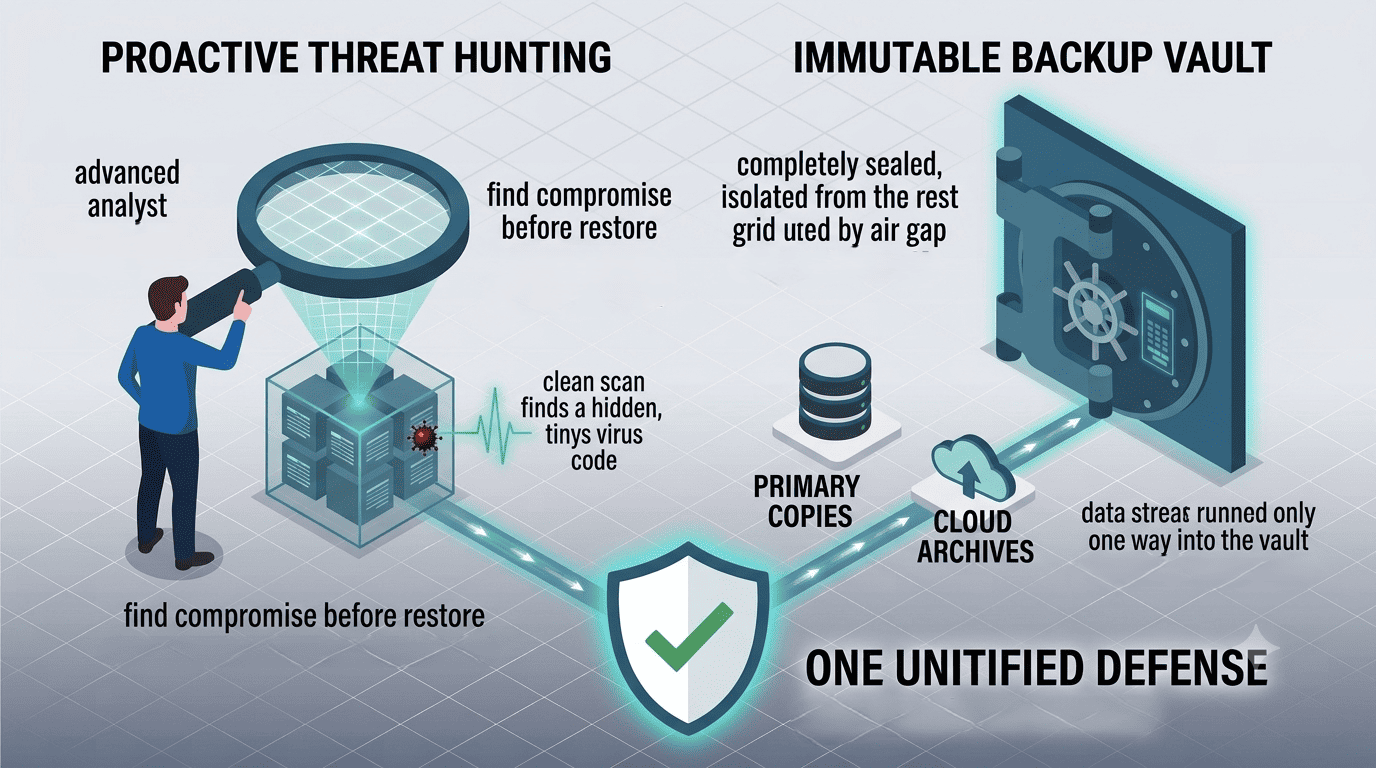
The layers cover each other's blind spots. Hunting shortens attacker dwell time and validates restore points; immutability ensures that even a missed intrusion cannot destroy your last line of defense. Healthcare organizations that operate both — often via a managed backup-as-a-service model when in-house security staffing is thin — enter incidents with options instead of ultimatums.
Conclusion
In healthcare, the question is not whether backups exist but whether they are clean, current, and restorable under pressure — and the only way to know is to look before the incident. Proactive threat hunting turns backups from an untested assumption into verified evidence, while immutable EU-hosted copies cap the damage when something slips through. Regulators, insurers, and patients are all, in their own way, asking for the same proof. If you'd like to assess how your current backup environment would hold up to a hunt, we're happy to take a look with you.
Frequently Asked Questions
What is threat hunting in backup systems?
Threat hunting in backup systems is the proactive search for signs of compromise inside backup repositories and restore points, rather than waiting for security alerts. Hunters look for anomalies such as unusual backup sizes, unexpected console access, altered retention policies, and known indicators of compromise inside restore points. The goal is to verify that backups are clean and usable before an incident forces the organization to rely on them.
Why do ransomware attackers target backups first?
Because backups are the victim's alternative to paying. Attackers typically spend days to weeks inside a network before encrypting, and use that time to locate, corrupt, or delete backup repositories and shadow copies. A victim with no usable backups faces a choice between paying the ransom and losing data permanently, which dramatically improves the attacker's negotiating position. Immutable, isolated copies remove that leverage.
How often should healthcare organizations test backup restores?
Quarterly at minimum, with critical clinical systems tested more frequently. Each test should restore real systems to an isolated environment, measure the actual time to recovery against the organization's RTO targets, and produce documented results. Under NIS2, this documentation doubles as compliance evidence — regulators and cyber insurers increasingly ask for proof of tested recovery rather than backup policies on paper.